
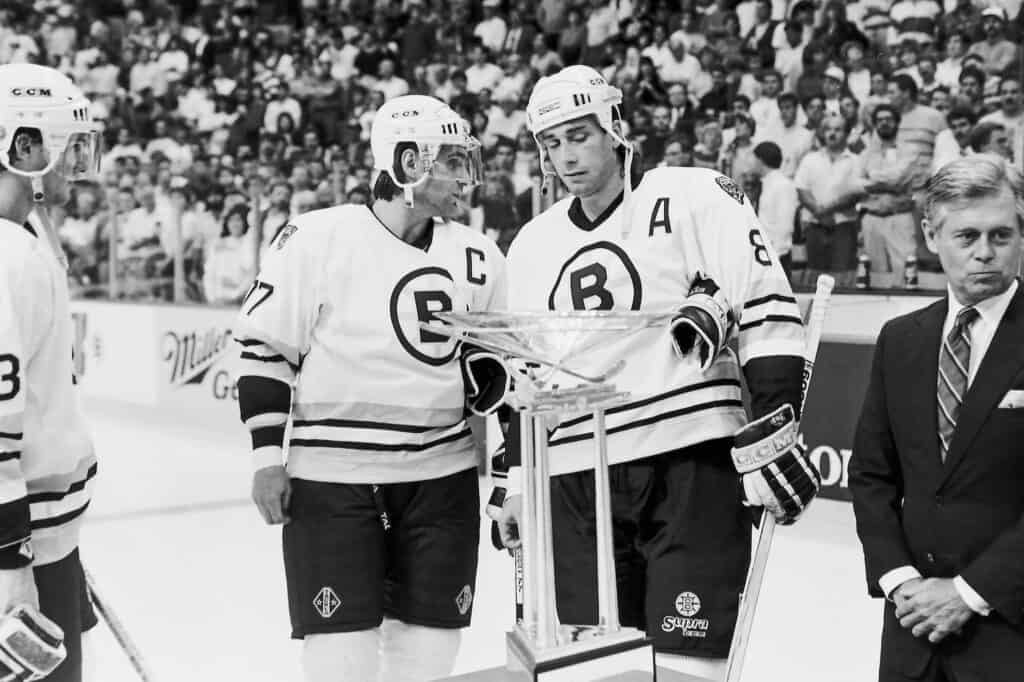

The Origins of Raymond Bourque and the Making of a Boston Bruins Franchise Defenseman
Raymond Bourque didn’t grow into greatness—he arrived wearing it. Long before the Boston Bruins adopted him as their heartbeat on the blue line, he was already turning heads in the QMJHL with the Laval National. His stride was smooth, his vision advanced, and his instincts belonged to a player a decade older.
When the Bruins drafted him 8th overall in 1979, they hoped they were getting a cornerstone. What they got instead was the foundation of their franchise for the next twenty years. In his rookie NHL season, Bourque delivered 65 points, won the Calder Trophy, and finished fourth in Norris Trophy voting—almost unheard of for a rookie defenseman. Not a bad first round draft pick.
He didn’t just enter the National Hockey League. He took command of it.
Early Career Timeline
| Year | Milestone |
|---|---|
| 1979 | Drafted 8th overall by Boston Bruins |
| 1980 | Wins Calder Trophy after a 65-point rookie season |
| 1985 | Named Bruins captain |
| 1987–1994 | Wins five Norris Trophies |
| 1990 | Leads Bruins to Stanley Cup Final |
| 1994 | Bruins fall to Devils in turning-point playoff series |
| 2000 | Traded to Colorado for a final Cup run |
| 2001 | Wins Stanley Cup; iconic Sakic handoff |
| 2004 | Hockey Hall of Fame induction |
Landing in Boston: How Bourque Became the Face of the Bruins
The Bourque–Park Connection and the Rise of a Bruins Defenseman
Some rookies shrink beside veterans. Bourque shined. Playing alongside Hall of Famer Brad Park accelerated his growth. Park provided steadiness; Bourque provided electricity. Together, they formed one of the most cerebral defensive pairings in Boston Bruins history.
Opponents quickly learned that if the Bruins needed stability, Bourque delivered it. If they needed offense, he sparked it. If they needed someone to erase an elite forward, he volunteered.
He didn’t just adapt to the NHL. He elevated it.
A Bruins Captain for 15 Years: Leadership That Defined an Era
In 1985, the obvious became official: Bourque was named captain. He wore the “C” for 15 seasons, the longest tenure in team history. Leadership wasn’t a role for him—it was his operating system.
Night after night, year after year, he played enormous minutes, dictated transition play, drove the power play, and anchored everything Boston attempted. He wasn’t simply the Bruins’ best defenseman. He was their compass.
Building a Dynasty of One: Boston Bruins Dominance Through the 1980s
The Bruins of the 1980s were a gritty, blue-collar orchestra. Bourque was the conductor. Season after season, Bourque dominated. He posted 70+ points and played shutdown defense with remarkable consistency. His slapshot became an unmistakable soundtrack inside Boston Garden.
He bridged the gap between Bobby Orr’s revolution and the rise of modern puck-moving NHL defensemen. By the end of the decade, Bourque wasn’t merely elite—he was the standard every other blueliner was measured against.
The 1990 Stanley Cup Run: Bourque Carrying Boston Toward Greatness
A Bruins Season Built on Hope and a Defenseman’s Dominance
The Boston Bruins hadn’t reached the Stanley Cup Final since 1978, but in 1990, everything aligned. Bourque was at the height of his NHL career—balanced, explosive, and unshakable. His command of transition play dictated Boston’s pace, and his two-way presence anchored every shift.
Every round demanded that Bourque be superhuman. And he was.
A Clash With a Dynasty-Level Opponent
The Edmonton Oilers—still a powerhouse even after Gretzky’s departure—waited in the Final. Their depth stretched Boston’s defense, and their relentless scoring overwhelmed the Bruins’ thinner supporting cast.
Boston fell in five games. It was crushing—not just because of the loss, but because it felt like Bourque had carried the entire city on his back.
And somehow, fans trusted him even more afterward.
1994 Heartbreak: New Jersey Devils, the Trap, and a Bruins Turning Point
A Defenseman at His Peak Meets a System Designed to Destroy Space
By 1994, Raymond Bourque remained one of the NHL’s most complete defensemen. But the Bruins ran headfirst into the New Jersey Devils’ neutral-zone trap—a suffocating system designed to eliminate passing lanes, slow transitions, and neutralize elite puck movers.
Bourque fought through it, but the Bruins fell short. That series marked a turning point: Boston’s long era of contention was diverging from its captain’s brilliance.
The franchise was changing. Bourque wasn’t.
The Late 1990s: A Bruins Icon Surrounded by Rebuilds
As the 1990s wound down, the Boston Bruins cycled through injuries, coaching shifts, and partial rebuilds. Bourque cycled through masterpieces. He delivered 50-, 60-, even 70-point seasons while still playing heavy defensive minutes and shutting down top scorers across the National Hockey League.
Younger Bruins defensemen leaned on him. Opponents game-planned around him. Fans clung to the hope he could somehow drag Boston back into Stanley Cup contender status.
But even legends can only carry so much.
Would he retire without the championship he deserved?
The Trade to the Colorado Avalanche: A Farewell Built on Love, Not Loss
March 6, 2000: A Bruins Legend Makes a Difficult Choice
When the Boston Bruins traded Ray Bourque to the Colorado Avalanche, the city didn’t feel betrayed—it felt grateful. Everyone recognized the truth: Boston could no longer offer him a legitimate Stanley Cup path.
Colorado, a true Stanley Cup contender with elite talent everywhere, could.
Sending Bourque away wasn’t rejection. It was respect.
As Joe Sakic put it:
“I’ve never seen a guy so respected by both teammates and opponents. Everyone wanted to see Ray win.”
Joe Sakic even offered to give up the C to make Ray Bourque the team captain.
Boston didn’t lose him.
They freed him.
The 2001 Colorado Avalanche Run: A Hollywood Ending for an NHL Defenseman
Colorado in 2000–01 was stacked: Sakic, Roy, Blake, Foote, Hejduk, Tanguay, Drury. Adding Ray Bourque didn’t fill a hole—it elevated the entire roster. He brought calm, clarity, and a refusal to let the moment slip.
His defensive reads sharpened. His puck movement steadied the Avalanche attack. His leadership filled whatever gaps remained.
June 9, 2001 — A Moment That Became Hockey Lore
Colorado defeated the Devils in Game 7. The arena erupted. Joe Sakic lifted the Cup, paused, and handed it directly to Bourque without taking a single stride.
One of the most iconic moments in NHL history.
After 22 years, Raymond Bourque was finally a Stanley Cup champion.

Ray Bourque’s Greatest Games and Most Iconic Moments
For a player who played more than 1,600 NHL games, narrowing down Ray Bourque’s greatest moments is almost impossible. But a handful of nights stand out not only for their brilliance, but for how they captured everything that made the Boston Bruins captain — and later the Colorado Avalanche champion — one of the greatest NHL defensemen in history.
The 1987 NHL All-Star Game: The Winning Goal on Home Ice
Boston Garden didn’t just host the 1987 All-Star Game — it vibrated with anticipation for its hometown hero. In a tight contest, Bourque stepped into open space, took a perfect feed, and ripped the game-winning goal past Grant Fuhr.
The arena’s eruption wasn’t just loud. It felt personal.
It remains one of the most beloved “regular season” moments in Bruins history, and one that showcased Bourque as one of the league’s must-watch players on the biggest stage.
The Night He Gave Up No. 7 for Phil Esposito — A Boston Bruins Moment for the Ages
Just months after that All-Star heroics, Bourque delivered one of the most iconic gestures in Boston Bruins history — and it didn’t happen during a game.
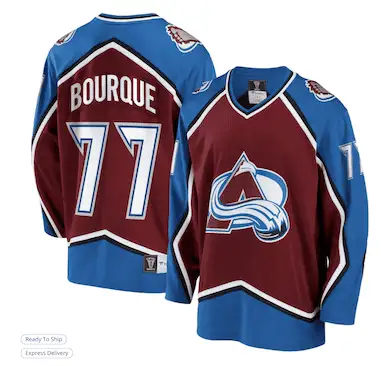
On December 3, 1987, during Phil Esposito’s jersey retirement ceremony, Bourque skated onto the ice wearing his usual No. 7. As the spotlight hit, he pulled off the jersey to reveal a new number underneath: 77.
He then handed Esposito the old No. 7 sweater, symbolically giving the number back to the legend who made it famous.
The arena erupted. Esposito was stunned.
And Bourque instantly became more than a great Bruins defenseman — he became a steward of the franchise’s history.
From that moment on, 77 became Ray Bourque’s signature, a number as closely tied to him in Boston as the rafters themselves.
The 1990 Stanley Cup Final — Game 3 Heroics
Although the Bruins fell short against the Edmonton Oilers in 1990, Bourque’s performance in Game 3 was unforgettable. With Boston desperate to claw back momentum, he dominated every shift — blocking shots, controlling the transition game, and nearly tilting the overtime in Boston’s favor with a dangerous chance in the slot.
It was the kind of game where a defenseman looks like a forward, goaltender, and general all at once.
Even in defeat, fans talked about that game for years.
March 26, 2000 — The Night Bourque Returned to Boston in Avalanche Colors
When Ray Bourque returned to the FleetCenter after the trade to the Colorado Avalanche, Bruins fans delivered one of the loudest and longest ovations in franchise history. They stood. They cheered. And they reminded the hockey world that respect comes from honesty — not geography.
Bourque’s salute to the crowd remains one of the most emotional and unique homecoming moments in NHL history.
Game 7 of the 2001 Stanley Cup Final — Delivering on Destiny
Game 7 against the New Jersey Devils wasn’t simply Colorado’s night. It was hockey’s attempt to restore order.
Bourque played 26 minutes, shut down the Devils’ top attackers, and made several game-saving defensive reads as the Avalanche built — and protected — their lead.
When the final horn sounded, cameras caught him collapsing into the celebration with a mix of exhaustion, joy, and relief.
If a single game could summarize a 22-year NHL career, this was it. Bourque’s dream of hoisting his first Stanley Cup was finally achieved.
The Jersey Number Retirement Ceremonies — Both Cities Claim Their Legend
Most NHL players are lucky to have their jersey retired by one franchise at the end of their hockey career. Bourque? He received that honor twice. After twenty-two seasons of hockey, Raymond Bourque would join hockey’s elite in two different franchises.
- Boston Bruins retired jersey number 77 in 2001, raising it to the rafters as one of the most emotional ceremonies in team history.
- Colorado Avalanche retired jersey number 77 in 2001 as well, an extraordinary move for a player who spent just 1.5 seasons with his second team.
It was the ultimate acknowledgment of impact — two fanbases, two franchises, one defenseman whose influence transcended geography.
Ray Bourque’s Top 10 Scoring Seasons
| Season | Points | Goals | Assists | Team |
|---|---|---|---|---|
| 1983–84 | 96 | 31 | 65 | Bruins |
| 1986–87 | 95 | 23 | 72 | Bruins |
| 1990–91 | 94 | 21 | 73 | Bruins |
| 1989–90 | 89 | 19 | 70 | Bruins |
| 1987–88 | 81 | 17 | 64 | Bruins |
| 1988–89 | 78 | 18 | 60 | Bruins |
| 1985–86 | 75 | 20 | 55 | Bruins |
| 1984–85 | 73 | 21 | 52 | Bruins |
| 1993–94 | 71 | 20 | 51 | Bruins |
| 1999–00 | 59 | 14 | 45 | Bruins / Avalanche |
Dissecting the Greatness: What Made Bourque One of the Most Complete NHL Defensemen Ever
The Skating and Control of the NHL Game
Bourque’s stride wasn’t flashy. It was efficient, powerful, and built for control. He dictated transitions before NHL teams even had analytics departments measuring them.
The Shot That Became Boston Bruins Lore
His slapshot was a controlled explosion. Goalies didn’t prepare for it—they braced for it. Few defensemen in NHL history combined accuracy and force the way Bourque did.
The Vision and Hockey IQ
Bourque anticipated plays as if the game moved in slow motion. Dangerous passes looked safe in his hands. His ability to read forecheckers separated him from even elite defensemen.
The Defense: Solving Shifts, Not Surviving Them
He didn’t overwhelm opponents with brute force. He dismantled them with angles, positioning, stickwork, and timing.
As Cam Neely once said:
“Ray Bourque is the most complete defenseman I ever played with. He could do it all—effortlessly.”
Where Raymond Bourque Ranks Among Bruins Defensemen and NHL Legends
Hockey’s greatest defensemen form a small, exclusive group:
- Bobby Orr — the revolutionary
- Nicklas Lidström — the perfectionist
- Paul Coffey — the offensive rocket
- Denis Potvin — the powerhouse
- Chris Pronger — the force of nature
Bourque?
He was the one who could do everything at an elite level for longer than anyone.
If Orr rewrote what a defenseman could be, Bourque perfected what a defenseman should be.
That’s why he appears in every serious conversation about:
- Greatest NHL defensemen
- Greatest Boston Bruins players
- Greatest two-way blueliners of all time
Legacy: Why Ray Bourque Still Matters to the Bruins, the Avalanche, and the Hockey Hall of Fame
The Blueprint for the Modern NHL Defenseman
Watch Cale Makar.
Watch Adam Fox.
Watch Charlie McAvoy.
Watch Quinn Hughes.
They’re all skating in the shadow of a template Bourque helped build.
The Records That Still Stand
- Most career points by a defenseman
- Most assists by a defenseman
- Nineteen NHL All-Star Game appearances
- Over 1,600 regular-season NHL games
These aren’t benchmarks. They’re monuments.
Beloved in Both Boston and Colorado
Even though he won his Cup with the Colorado Avalanche, Bourque never stopped being a Boston Bruins icon. Bruins defensemen still talk about him as the standard. Avalanche fans still cherish the one perfect season he gave them.
His 2004 induction into the Hockey Hall of Fame only confirmed what everyone already knew: Bourque wasn’t just great. He was generational.
The Final Buzzer
Ray Bourque never needed a Stanley Cup to validate his greatness. But the night he finally lifted it—Sakic handing it over, the crowd erupting, two decades of weight dissolving—it felt like the sport itself was exhaling.
He didn’t just redefine what a defenseman could be.
He embodied what an NHL legend looks like.
His brilliance still echoes in highlight reels, in stat sheets, in the rafters of TD Garden, and in the play of every modern two-way defenseman trying to combine skill with reliability.
Raymond Bourque wasn’t simply one of the greatest NHL defensemen ever.
He was—and remains—a compass for greatness.
Long after the cheers faded, hockey never stopped following his lead.